What is a time capsule? Origin, principle and evolution of a timeless gesture
Discover the origins of the time capsule, its principle and how it has evolved. From Antiquity to the digital age: the history of a timeless gesture.
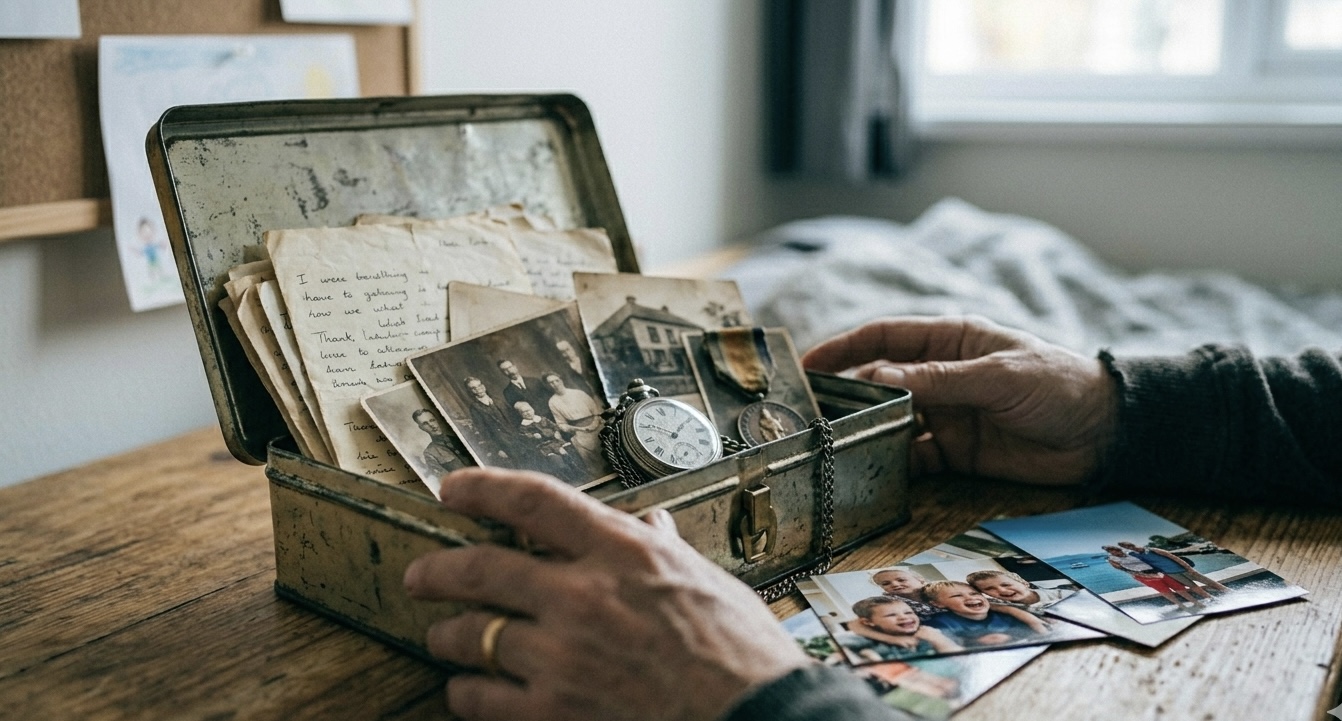
You've heard of time capsules. Maybe the idea intrigues you. Maybe you're wondering where it comes from. Why we do it. How it works.
A time capsule is simple: you collect objects, messages, memories. Lock them away. Program them to be opened later. In a few years. A generation from now. Sometimes even centuries from now.
The gesture is as old as the hills. But the modern concept has a precise history. And it has evolved considerably.
Today, we don't make time capsules like we used to. Digital technology has changed everything. But the intention remains the same: to transmit something in time. To preserve a moment. To leave a trace.
This article explores the origins of the time capsule, its fundamental principle, and how it evolved to become what it is today.
Why we've always wanted to leave messages in time
The need to transmit something to the future is not new. It's deeply human.
Because we know we're going to disappear
Humans have always known they were mortal. And this awareness creates an urgency: to leave a trace. To say we've been there.
The pyramids. The ornate caves. Engraved stones. These are all ancient forms of time capsules.
Because we want to transmit something
Not just exist. But to pass on. Knowledge. Values. Stories. Emotions.
Each generation wants to say something to the next. The time capsule is just one concrete form of this intention.
Because we want them to remember
Who were our ancestors? How did they live? What was important to them?
Without traces, these questions remain unanswered. The time capsule is a way of guaranteeing that we'll remember.
The origin of the modern time capsule
The concept as we know it today has a recent history.
The first real time capsules
The term "time capsule" first appeared in 1939. At the New York World's Fair.
The Westinghouse Electric Corporation creates a cylindrical capsule in metal alloy. Designed to last 5,000 years. Buried at a depth of 15 meters.
Contents: everyday objects from 1939. Newspapers. Films. Seeds. A letter to humans from the year 6939.
It's the first time capsule thought up as such. With a precise opening date. A clear intention of transmission.
The explosion of the concept in the 20th century
After 1939, the concept became increasingly popular. Especially during the Cold War.
People wanted to leave a trace, just in case. In case civilization disappeared. In case everything is destroyed.
Thousands of time capsules are created. In schools. Companies. Towns. Churches.
Some are still buried somewhere. Forgotten. Others have been opened. With emotion. With surprise.
Space capsules
The Voyager 1 and 2 probes, launched in 1977, carry "golden disks". These are time capsules intended for possible extraterrestrial civilizations.
Contents: sounds from Earth. Music. Pictures. Greetings in 55 languages.
These capsules will probably never be opened. But they do exist. They travel through space. Forever.
The basic principle of a time capsule
Beyond the story, there's a simple principle.
Freeze a moment
A time capsule captures a moment in time. It says, "This is what was then. This is who we were."
It's a freeze frame. But in 3D. With objects. Text. Sounds.
Program opening
What distinguishes a time capsule from a simple archive is the opening date.
It's not meant to be opened now. It's meant to be opened later. In 10 years. In 50 years. In 5,000 years.
This expectation creates anticipation. Mystery. Value.
Creating a bridge in time
A time capsule links two eras. It says: "We, from the past, speak to you, from the future."
It's a conversation across time. A dialogue impossible otherwise.
The traditional contents of a time capsule
Historically, time capsules contained physical objects.
Everyday objects
Coins. Newspapers. Toys. Technological gadgets of the time.
These objects, commonplace today, become fascinating 50 years from now. They tell the story of an era.
Written messages
Letters. Testimonials. Predictions about the future.
"We think that in 50 years, you'll have..."
These texts reveal as much about those who wrote them as they do about the times they describe.
Photos and documents
Pictures of the period. Building plans. Maps.
Anything to visualize what the world looked like at the time.
Cultural samples
Music on period media. Movies. Books.
Anything that speaks to the culture, values and concerns of the time.
How to create a modern time capsule
The principle remains the same. But the method has evolved.
Decide on the intention
Why are you creating this capsule? Who's it for? For whom?
This intention guides everything else. A family capsule doesn't have the same content as a school capsule.
Gather content
Collect what tells the story of your time. What tells the story of your life. What really matters.
Take your time. Select. Keep only the essentials.
Choose support
Physical or digital? Both have their advantages.
Physical is tangible. Digital is complete and durable.
Program opening
Choose the date. Be precise. This date turns your collection into a time capsule.
Without an opening date, it's just an archive. With a date, it becomes an appointment.
The role of digital time capsules today
Digital technology has profoundly transformed the concept.
All possible formats
Before, you were limited to physical objects. Today, you can include anything.
Photos. Videos. Audio recordings. Text messages. Music playlists.
Anything that exists in digital form can be preserved.
No degradation
Physical objects age. Paper turns yellow. Photos fade.
Digital doesn't degrade. A digital photo in 10 years will look exactly the same as it does today.
Automatic programming
With a physical capsule, you have to remember the date. Organize the opening.
With a digital capsule, opening is automatic. Programmed. Reliable.
Universal accessibility
A physical capsule is in a single location. A digital capsule can be opened by several people. Even from a distance.
This is particularly useful for families that live far apart.
With Memixo, you can create digital time capsules in any format, and program them to open up to 10 years in the future.
Frequently asked questions about time capsules
What's the difference between a time capsule and an archive?
The scheduled opening date. An archive can be accessed immediately. A time capsule waits for its moment.
How long can a time capsule be programmed?
It depends on the type. Historical time capsules can be programmed for millennia. Personal or family time capsules are generally programmed between a few months and 10 years.
Can I open a time capsule before the scheduled date?
With a physical capsule, technically yes. With a digital time capsule, they are generally sealed until the opening date.
What makes a good time capsule?
A clear intention. Authentic content. An opening date that makes sense. And above all: no censorship. Be honest. The future doesn't want a perfect version. It wants the truth.
Are time capsules always found?
No. Many physical capsules have been lost. Forgotten during moves. Destroyed during renovations. That's one of the advantages of digital technology: traceability.
An ancient gesture, a modern practice
The time capsule is not a recent invention. It's the continuation of a gesture as old as humanity itself: leaving a trace. To transmit something. To speak to the future.
What has changed is the method. It used to be engraved in stone. We buried objects. Today, we create digital capsules. We program automatic openings.
But the intention remains the same. To say: "We were there. This is who we were. This is what mattered to us.
And when that capsule opens, in a few years' time, it will create a rare moment. A moment where the past meets the present. Where those who created it speak to those who open it.
It's simple. But powerful. Because time passes. Because we forget. Because some messages are worth preserving.
And because a time capsule, at its core, is just a way of saying, "We'll miss you. And we hope you'll remember."
Do you have a message to send through time?
Memixo lets you create digital time capsules for the people who matter. Simple, secure, built to last.
Try for free