Physical or digital time capsule: which to choose for your memories
Physical or digital time capsules? Advantages, disadvantages, durability, formats. Compare the two solutions and choose the one that's right for you.
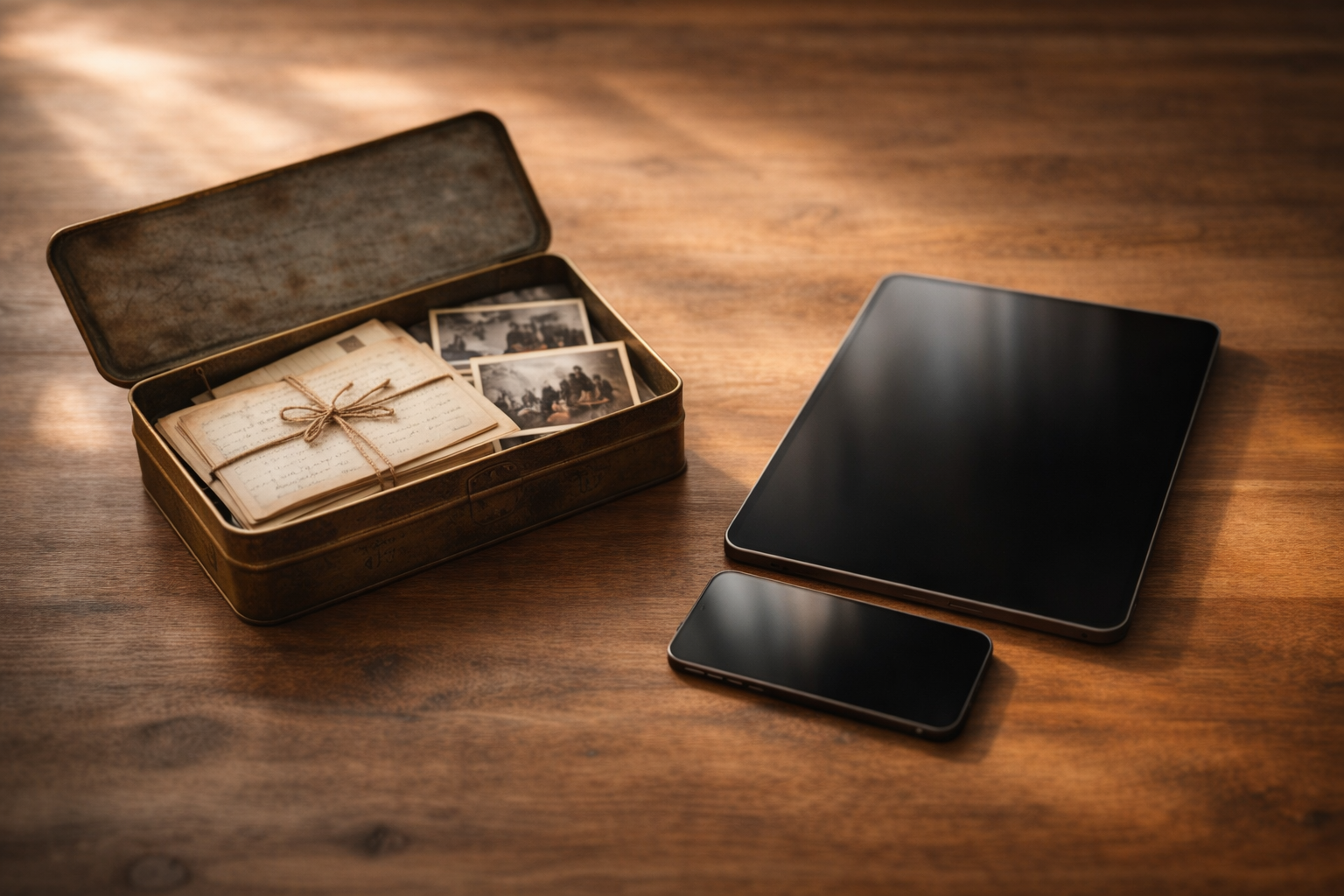
You want to create a time capsule. Collect memories, messages, photos. Preserve them for later.
But you're not sure. Physical capsule in a box? Or a digital capsule on the Internet?
Both exist. Both work. But they don't meet the same needs. And they don't have the same advantages or the same limitations.
A physical capsule is concrete. You touch it. You put it in a box. You hide it somewhere. There's something reassuring about this materiality.
A digital capsule is practical. You gather everything in one place. Photos, videos, text, audio. You program it to open. It's automatic.
But how do you choose? What's best for your project?
This guide will help you understand the differences. The advantages of each solution. The limitations too. So you can make an informed choice.
Why support matters
The media you choose isn't just a technical detail. It influences your entire approach.
Because it changes what you can communicate
With a physical capsule, you're limited to paper and objects. Letters, printed photos, small symbolic objects.
With a digital capsule, you can include everything. Photos, videos, audio recordings, text messages, music playlists.
Digital technology opens up possibilities that physical technology doesn't.
Because it changes sustainability
A box can get lost in a move. Paper turns yellow. Ink fades. Photos fade.
The digital content does not deteriorate. If the service shuts down, there are often guarantees regarding the retrieval of the capsules. If you lose your login details, you can always contact customer support to recover them.
Because it changes the opening
With a physical capsule, you have to remember the date. Find the box. Open it together.
With a digital capsule, opening is automatic. Programmed. You don't have to do a thing. It just happens.
Both have their charm. But not the same logistics.
The advantages of the physical time capsule
Let's start with the physical. What makes it unique?
Materiality and touch
There's something powerful about holding a handwritten letter. To touch an object that once belonged to someone.
Digital technology can't reproduce that.
If you want to pass on a physical object - a medal, a childhood toy, a key - the physical is indispensable.
Technological independence
No need for the Internet. You don't need an account. You don't need electricity.
A closed box in a closet works. Even 50 years from now.
For some, this independence is reassuring.
The opening ritual
Opening a box together is a moment. We get together. We open. We discover together.
There's a ceremonial dimension that digital technology has trouble reproducing.
The limits of the physical time capsule
But the physical world also has its drawbacks.
Fragile media
Paper turns yellow. Photos fade. Ink fades. Objects deteriorate.
In 20 years, your physical capsule will have aged. Sometimes a lot.
The risk of loss
Moving. Floods. Fires. Forgetfulness.
A physical box can definitely get lost.
Limited formats
You can't put a video in a box. Nor an audio recording. Nor a music playlist.
You're limited to paper and objects.
For many modern souvenirs, that's too restrictive.
Manual programming
You have to remember the date. Find the box. Organize opening.
If you're creating a capsule for your child's 18th birthday, you need to remember it 18 years from now.
It can be done. But it's a mental burden.
Advantages of the digital time capsule
Let's go digital. What makes it interesting?
All formats in one place
Photos, videos, text, audio, playlists: everything together.
Film a video message. Add photos. Write a letter. Include an audio recording.
This wealth of formats creates much more complete capsules.
No degradation over time
A digital photo in 10 years will look exactly the same as it does today.
No yellowing. No fading. No degradation.
Digital does not age.
Automatic programming
You create today. You program for June 15, 2030 at 8am.
It happens automatically. No need to remember. No need to find anything.
It's simple. It's reliable.
Remote accessibility
If you create a capsule for several people, everyone can access it. Even if they're in different countries.
Everyone receives the link. Everyone can open at the same time.
This is particularly useful for families that live far apart.
The ability to delete
You create a capsule. But you change your mind before the opening.
With digital, you can delete it. You're in control all the way.
With the physical, once the box is sealed, it's more complicated.
The limits of the digital time capsule
Digital isn't perfect either.
Service dependency
If the service you use closes, your capsule may disappear.
That's why you need to choose a reliable service. Perennial. Designed to last.
The absence of materiality
You can't touch a digital capsule. You can't physically open it.
For some people, this takes away the charm. Weight.
It's a question of personal sensitivity.
The need for internet access
To open a digital capsule, you need the Internet. And a device.
In 10 years, this probably won't be a problem. But it is a technological dependency.
How to choose between physical and digital
So, which to choose? Here are a few hints.
Choose physical if:
∙ You want to transmit concrete objects
∙ You prefer materiality and touch
∙ You want total independence from technology
∙ You like the idea of a physical opening ritual
∙ You're sure you won't be moving often
Choose digital if:
∙ You want to include videos, audios, playlists
∙ You want automatic programming
∙ You want to avoid media degradation
∙ You create for several geographically dispersed people
∙ You want to be able to modify or delete before opening
Or combine both
There's nothing to stop you from doing both.
Create a digital capsule for all modern formats. And add a small physical box with a few symbolic objects.
The two complement each other more than they oppose.
The role of digital time capsules today
Digital technology has profoundly changed the way time capsules are created.
Before, we were limited to paper. Today, we can bring together all formats. All the dimensions of a memory.
A video of you talking. A photo. A written message. An audio recording. A playlist of songs from the time.
All together. In a single capsule. Programmed to open at the exact moment you choose.
It's this richness that makes digital so powerful. Not to replace the physical. But to enable what the physical can't.
Memixo lets you create these digital time capsules, collect text, photos, videos and audio recordings, and program them to open up to 10 years into the future.
Frequently asked questions about the choice between physical and digital
Is digital really reliable over 10 years?
If you use a dedicated, long-term service like Memixo, yes. It's even more reliable than a box that might get lost in a move.
Can you do both at the same time?
Absolutely. You can create a digital capsule AND a small physical box with a few objects. The two complement each other.
Isn't the physical more "authentic"?
It's a question of perception. A video of you talking has as much authenticity as a handwritten letter. They're just different forms.
What if I don't have any physical objects to transmit?
Then digital is probably more suitable. You don't need to force the creation of a physical box just to "do it the old way".
How long can a digital capsule be programmed?
With services like Memixo, up to 10 years maximum. That's more than enough time for most projects.
Choose according to what you want to convey
Ultimately, the right choice depends on what you want to preserve.
If it's an object, a piece of jewelry, a medal: looks are essential.
If it's your voice, your face in motion, family videos: digital is irreplaceable.
If it's a mixture of both: combine.
It's not the medium that's important. It's the intention. What you want to convey. To whom. To when.
The rest is just logistics. And today there are solutions for every need.
Do you have a message to send through time?
Memixo lets you create digital time capsules for the people who matter. Simple, secure, built to last.
Try for free